Cross Keys Swing Bridge, Sutton Bridge, Lincolnshire

Menu:

BRIDGE VOICES

REMINISCENCES OF SUTTON BRIDGE


THE WOOD TRAIN

I wonder how many folk in Sutton Bridge remember the wood train that used to go from Wisbech to Travis and Arnold’s yard at Sutton Bridge? - Quite a number of long-standing residents of the town, I’m sure 92 year old Mister Jack for one..

He arrived in Sutton Bridge when it was entirely an ‘agricultural village’, when most people worked on the land, often doing back-breaking work. He came to work for Travis Arnold, timber merchants, and worked his way up to become the manager. He recalls sitting in his office looking out across the river at between 3.30 and 4pm every day to see bicycle upon bicycle streaming along East Bank towards the Bridge, as the workers left the fields to return home.

The Wood Train at Sutton Bridge

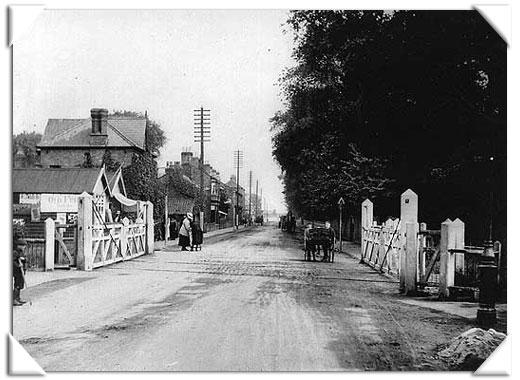
The photograph above shows timber in wagons crossing at the gates at New Road, Sutton Bridge. You can make out the roof line of Cindy’s (top left). This was a private line and British Rail engines could not haul the trucks directly into Travis Arnold’s yard (BR regulations) so the engine was unhitched and the trucks shunted into the yard, where they were unloaded.

Jack said the import of wood at the port was stopped during the War and afterwards there were fewer ships using it. Sutton Bridge was an NAA (Not always afloat) port, which meant that ships had to rest on the silt in the middle of the river at low tides and were not so stable as in other ports where deep water ensured boats had a good anchorage. Even today, the boats moored at the modern port are not floating, but resting on clay.

The railway crossing across Bridge Road, Sutton Bridge
The railway crossing across Bridge Road, Sutton Bridge, near New Road.

Photo taken early 20th century. Notice the man and his son and their handcart - could he be a knife-grinder? The man seems to be sitting at his cart.


¦ ⇑ Back to top of page ⇑ ¦

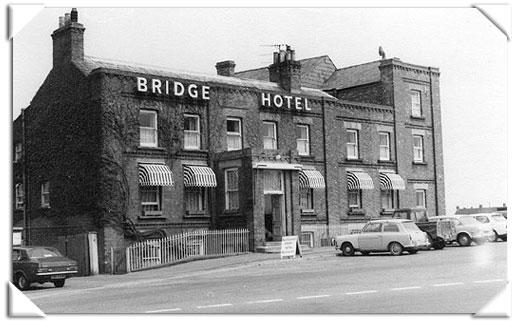
DINNER-DANCES AT THE BRIDGE HOTEL

Jack Earley, one of Sutton Bridge’s long-standing residents, remembers the dinner-dances that were held at the Bridge Hotel. The hotel was the social centre for the district and the functions that were held were attended by people from miles around. It was owned by Soames Brewery (Norwich) and the manager and his wife – Tom and Sadie Burns – would greet their guests in evening dress. Dancing was popular in the fifties and people like to dress up when they went out. It was probably a reaction from the austerities of the war, when everything was rationed. Clothing rations continued until 1949.

The Bridge Hotel, Sutton Bridge

Jack and his wife Olive like dancing. He recalls that they met at a dance – in 1942 at a Regimental Dance in the Rink Ballroom, Sunderland. His eye had been caught by a young lady in a blue lace dress and he decided he’d like to have a dance with her. Each time the music started for the next dance, he was beaten to it by others with the same intention as himself. This happened three times and by that time, Jack said ‘he was getting a bit mad’. However this made him all the more determined and as soon as the music started again, he was there, and ‘pounced’ on Olive and led her on to the floor. This was in February 1942; in December, they married.

Bridge Hotel staff in 1953
Staff at The Bridge Hotel, Christmas 1953.
Backrow right: Mrs Richardson (next to gentleman in patterned pullover)
Seated in front of her, left, is Mrs Wally Taylor.

Can anyone say if the couple seated centre are Tom and Sadie Burns, the managers of the hotel? Is anyone able to name other people?

Jack said another venue for dancing was the Barn Restaurant in Bridge Road, in what had previously been the cinema, on the site between the old school and the hardware store. He and Olive regularly went dancing here too.

The old cinema in Bridge Road, which later became the Barn Restaurant
The old cinema in Bridge Road, which later became the Barn Restaurant.


¦ ⇑ Back to top of page ⇑ ¦

SUTTON BRIDGE SCHOOLS

Wharf Street School

Albert Cooper and his brothers, Alfred and Ernie all attended the boys’ primary school in Wharf Street, as did Leslie Garner and his brother David. Both Albert and Leslie were in the same class and remember clearly Miss Mitchell, who was the head teacher at the time, and Miss Bevan, who took the infant class.

Apparently, Miss Mitchell was a stickler for hygiene and would regularly inspect her pupils’ fingernails. If she found a trace of dirt, she would give the boy a pin to clean his nails! Hair inspections were routine. If a boy was found with nits, he would be told to use a comb with fine tooth to get rid of them. Leslie said he made sure he never got nits!

Looking at his school reports, recently, Leslie recalls that he liked crafts but not languages but that he was reasonably good at Maths.

Leslie also remembers that many of the children came to school in ragged clothes and some wore no shoes.

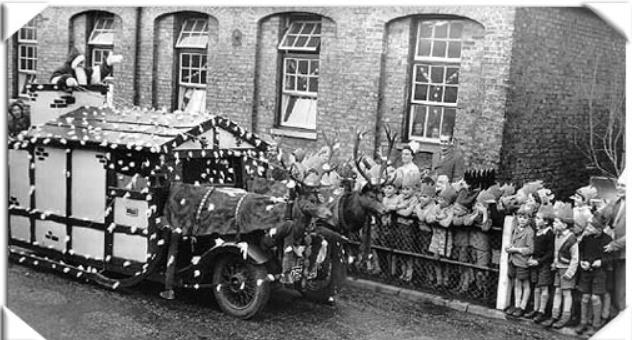
Both men remember times when Father Christmas came round to the school. Albert was able to shed light on the photograph below. It was taken during the fifties, he said, long after his and Leslie’s time as pupils! Albert said a garage proprietor from Holbeach, Geoff Parker, used the Morris Cowley (disguised as Father Christmas’s sleigh), which he had adapted to take Father Christmas’s house and chimney on top . He had also installed two extra levers inside the car to enable the driver to move the reindeer’s legs to make it look as though they were galloping along. Clearly the pupils at the school were delighted when Father Christmas came to call.

Wharf Street School, Sutton Bridge
Father Christmas visits the Wharf Street School, Sutton Bridge, in the fifties

Perhaps someone, still living in Sutton Bridge was one of the children in the photo and remembers either themselves and the occasion, or the names of the teachers. If so, please contact us at info@bridgewatch.org.uk

Girls attended a primary school in Church Street. The two schools were built by the Guy’s Hospital Trust for the children of the dock workers. Both Leslie’s father and his grandfather went to the school, his grandfather attending from when it first opened in 1895. Both schools have long since been pulled down. Some say that the girls’ school became the Village Hall when a new hall was built near the Memorial Park and the Church Street building became the Salvation Army Hall. It was later demolished to make way for a house.

The boys’ school is now Leslie’s home and his back garden has been made from the original playground. The playground perimeter wall is still there and the entrance from it to the three air raid shelters beyond has been bricked up and a gate made further along to give access to the space behind which is now a vegetable plot and fruit garden. The air raid shelters were built during the war to provide a safe refuge for the children. They were so well constructed that they are today clean and dry and have the original distemper on the walls.

Bridge Road Council School

After leaving Wharf Street School, Albert went to the Council School in Bridge Road when a Mr Hepenstall was the Head Teacher. The school was built to accommodate 150 boys and 150 girls. Albert recalls Mr Hepenstall as being ‘the most horrible man he had ever met’. Explaining, he said that children like him, from poorer families, would get belted for everything.

Bridge Road Council School, Sutton Bridge
The Council School in Bridge Road around 1900

When Mr Hepenstall left the new headteacher was Mr WR Dickens (known locally as ‘Billy’) and things got better especially when another teacher joined the school – Mr Lol Mallett, who took the top class. Albert described him as a ‘perfect gentleman’.


¦ ⇑ Back to top of page ⇑ ¦

Hans, the Barber of Sutton Bridge

There’s probably not a person in Sutton Bridge who does not know Hans, the barber of High Street. His premises are now closed since Hans retired nearly three years ago, when he was 82.

Hans Heib arrived in Sutton Bridge after the war. He had been a prisoner of war and was released in 1948. He had the choice to return to Germany or to stay here. To stay in England, he had to have a guarantor and a job and work on the land. He was living in the hostel for POW’s on West Bank, near where Travis & Arnold had their warehouse, and worked near Gedney Dyke. He was able to come and go as he pleased.

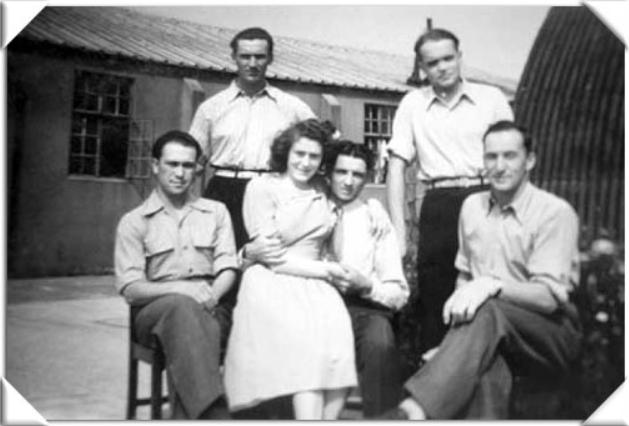
A group of the German POW’s at the Sutton Bridge Camp
A group of the German POW’s at the Sutton Bridge Camp on the West Bank, near what was Travis & Arnold’s warehouse and offices. Audrey, Hans’ girlfriend (later to become his wife) sits on his knee. The couple are surrounded by four friends: Helmut Folket, Johnny Rill, Tibor Kasat and Emery Kurt.

In 1950 he got a job as a barber at the USAF air bases at Sculthorpe and Lakenheath. Hans said it was good pay. For twenty years he travelled back and forth to the bases in his car. He said there were twelve barbers at the American bases. When asked why so many, Hans said: ‘With several thousand airmen who had to have a haircut every week, that would be a lot of work for just one man!’

Sutton Bridge had three barber shops then and when one of the barbers decided to close, Hans opened up his own shop. He said now that he was his own boss he could buy himself a better car than the older one he used to travel between Sutton Bridge and Lakenheath and Sculthorpe. He said it was 41 miles there and back to Lakenheath and took about an hour each way.

Hans Heib and some of his friends from the Sculthorpe US Base
Hans Heib and some of his fellow barbers from the US base at Sculthorpe with their wives and girlfriends on a night out at a Fakenham Hotel. Hans and his wife Audrey are the couple in the centre.

Hans had always wanted to be a barber, ever since he was a small boy living in Romania, where he was born in 1924. His uncle was a barber and rather than work on the land, Hans decided he, too, wanted to follow in his uncle’s footsteps. So after leaving school at fourteen and a half, he was apprenticed to a barber in Timisoara. His uncle told him that when he had finished his apprenticeship, he could come home and work for him. ‘It never materialised,’ said Hans, ‘War broke out in 1939 and I went into the German army.’ He was just seventeen and a half.


¦ ⇑ Back to top of page ⇑ ¦

Samphire

Samphire is a delicacy enjoyed by many local people and the folk of Sutton Bridge are no exception. If you enjoy freshly harvested, freshly cooked samphire with butter and vinegar, have you ever wondered how it got you your plate? You may have bought it locally from a fishmonger, a market stall or farm shop, but how did it reach these places in the first place?

A plate full of Samphire

It has been the tradition over the generations for local people to harvest samphire around the Wash and North Norfolk coast. It grows on the marsh and is gathered at low tide. That means getting up very early — often in the middle of the night for some — to go down to the shore and gather it in.

I met one such gatherer — I’ll call him Bill — one morning recently, at half past six. He was returning from his labours trundling several sacks of samphire bundled precariously on his small fold-up bicycle. He told me he had left his home at 2.30am and was out on the marsh by three in order to catch the low tide. I told him we used to pick samphire ourselves but it seems to have disappeared from where we picked it.

‘Samphire is a long way out now,’ said Bill, ‘you have to go farther out.’

Bill used to be a fisherman off the North Norfolk coast and has been harvesting from the sea ever since he was a lad and used to collect a few cockles and ‘sell them for a few bob’ so that he had ‘enough money to go to the pictures on a Saturday afternoon.’

Bill exercises Common Rights. Traditional activities, like samphire collecting, remain sustainable because casual/recreational harvesters gather only enough for their own needs or to share.


¦ ⇑ Back to top of page ⇑ ¦

Community Service – a personal view

Jack Earley, who at 92, is one of the oldest residents of Sutton Bridge, remembers a time when public service was considered to be a noble activity. Although he was not born in Sutton Bridge, he has lived here since 1946. At one time he was the Chairman of the Parish Council at the time when Arnie Broughton was the Vice-chairman. He said he didn’t always see eye to eye with Arnie, but he respected him enormously. Jack was interested in civic matters and thought serving the community where he had made his home very important. So much so that he found time to act as Chairman of the British Legion as well. Today he is the President of the British Legion in Sutton Bridge.

Jack remembers being responsible for organising various events in the village, including, in the early fifties, a big Gala Day, now part of folk memory! It was held in the Memorial Park. Jack recalled the big tent where fruits and vegetables were displayed and judged. There was also a central ring where children’s sports took place, as well as the usual side shows, and of course, a very popular beer tent. Jack remembers that one year he ‘won a pig’ in a skittles contest. He was a bit worried as he had no idea what he would do with a whole pig and just as he was deep in thought about it, someone offered to buy it from him for £5! He said that back then, lots of people kept pigs on their allotments, or in their back gardens.

Jack said the Gala Days continued for a few years, but as the organisation of it was left to a few people and there were fewer and fewer people willing to take on the running of it, it was discontinued after a few years. He said there are still a few people living in the village who remember the Gala Days with fondness.

Over the years different people stepped forward to organise other Gala Days, and in the nineties, the Country Fayres. These will be the subject of a future article. There have recently been suggestions that perhaps the ‘Gala’/Country Fayre/village fete idea should be resurrected. The Memorial Park is a good local amenity and offers an excellent place for the community to gather. Such an event could have displays of flowers, fruit and vegetables on show as well as giving opportunities to local businesses and volunteer groups to showcase their activities. It would build on the village’s entry into the East Midlands in Bloom Competition.

Asked why he thought Sutton Bridge had never developed a strong sense of community, Jack suggested it was because the village grew up along what was originally a track from Long Sutton, which travellers and merchants used on their way to and from King’s Lynn, Norwich and the east coast ports. The travellers used Sutton Bridge as a staging post waiting for the tide and the guides to take them across. The railway and the bridge served the same function.

Over time, he added, a few houses and shops were built along the roadway and the linear development we see today began. Unlike Long Sutton, Sutton Bridge does not have a centre. Rather it has two ends: the East End and the West End. Today, according to Jack, it follows the same pattern. Sutton Bridge is squeezed in between the new A17 and farmland and traffic passes by or through.

However, some community events have taken place in the village during the recent past: the long-running Art Exhibition at St Matthew’s Church, The Big Bloomers tremendous efforts to improve the image of Sutton Bridge by entering into the East Midlands in Bloom Competition; past and present Community Centre Committee’s fundraising events, including the recent Community Centre Fund’s big sale to raise money to build the new village hall; an event organised by the Bridge for Heroes’ project — a Family Fun Day; as well as the on-going PlaceCheck Project, which is already beginning to generate community spirit in the part of the village centering on the school.


¦ ⇑ Back to top of page ⇑ ¦

Holiday Playscheme - Community Spirit Starts Young

In 1975 a two-week Holiday Playscheme was started in Sutton Bridge during August and aimed to give children aged between 7-14 opportunities to play in a safe environment. The idea was to provide a place where children could ‘do their own thing’ under the ‘benevolent eye’ of a Play Leader. It was organised by a Voluntary Committee with funding from South Holland District Council and Sutton Bridge Parish Council and donations from local people. The money bought play equipment and was supplemented by other donated items. It also paid for the services of a trained Playleader. It was so popular that it continued for at least twelve years.

Sutton Bridge Holiday Playscheme photo taken in 1976 by the Wisbech Standard

The Playscheme took place in Memorial Park and the Scout Hut and the Church Hall were also used. In the later years, a caravan was used to store equipment. Among the activities organised were football, cricket, team games, fancy dress and talent competitions, tug-o-war, trips to Hunstanton, Mablethorpe and Wicksteed Park, and other places, as well as local visits to the Bridge and the Church Tower. Visitors to the Scheme were the Lincolnshire fire Brigade and the Lincolnshire Road Show community theatre. Money was raised, by among other things, organising discos, which were very successful.

An article in the Lincolnshire Free Press of May 17th 1976 reported that the Playscheme was ‘one of the most successful to be run throughout Lincolnshire’ the previous year and as a result, SHDC had agreed to finance 50% of the costs for 1976. It was generally agreed that the Playscheme helped to cut down on the amount of vandalism caused by young people. “ Playschemes took children off the streets and provided them with creative activities,” said Mr Trevor Muhl, deputy secretary of the Lincolnshire Association of Local Associations, speaking at the Sutton Bridge Annual Assembly.

Sutton Bridge Holiday Playscheme photo taken in 1979 by Lynn News

Parents agreed. One mother was pleased because it meant she didn’t have to take her children to work with her. Another said her children didn’t have to work in the carrot-topping factory. For children living on outlying farms, it meant they could play with their school friends during the holiday. Another boy was kept occupied and didn’t get into trouble with the police. Children, too, were full of praise: an eleven-year-old boy went every year because the games were good and thought the playleaders were great for joining in. A thirteen-year old girl enjoyed the outings and said she would like to help the following year if she were too old to join when she would be fourteen.

Sutton Bridge Holiday Playscheme photo taken in 1985 by the Lincolnshire Free Press

A film was made showing the children of Sutton Bridge and other Playscheme centres participating in a variety of activities. Mr Muhl said that Playschemes not only created a ‘tremendous amount of community spirit’ amongst the children, but also engendered a sense of ‘get-togetherness’ among the organising committees, who also achieved a great deal of satisfaction from running them.

Sutton Bridge Holiday Playscheme photo taken in 1985 by the Spalding Guardian

Those organising the Playschemes recognised that play is an important aspect of growing up. Over the years a number of people helped to run the scheme. It requires time and commitment to keep such schemes up and running. The people who organised the playschemes for the children of Sutton Bridge deserve to be congratulated.

Perhaps some of the children in the photographs may recognise themselves and if so, Bridge Watch would like to hear from them. Contact us at info@bridgewatch.org.uk and we would be delighted to include your comments under this article.

Acknowledgements: Mr Jim Stratton, whose wife Christine, was one of the Playscheme organisers in the later years.
Photographs courtesy of : Wisbech Standard, Lynn News, Spalding Guardian, Lincolnshire Free Press — 1975-1987


¦ ⇑ Back to top of page ⇑ ¦

The Cheese Shop

The Cheese Shop sign

The Cheese Shop in Hospital Road, off East Bank, has been closed now since 2004, and we are very saddened to learn that the owner, Mr. Ronald Bedford, passed away in May 2010. I am sure many of his old customers miss him and his shop very much.

It was always a pleasure to visit the Cheese Shop. If Ron was not already in the shop, he would soon appear wearing his spotless apron and straw boater hat. It was a most popular establishment. If another customer was not already there when you arrived, there usually was by the time you left.

Mr. Ronald Bedford in The Cheese Shop

Mr. Bedford’s account of how he and his wife came to open the Cheese Shop in 1986 is both interesting and amusing. They used to run a very busy public house in Wymondham in Leicestershire, and looking to their eventual retirement, they decided to buy a house in Wingland. How this came about was when one of the delivery men to their pub left them his local newspaper, “The Spalding Guardian”, and looking through the newspaper saw the house on Wingland advertised and so decided they would like to have a look it at. Their son, Clive, managed the pub for them while they came to view. On viewing they immediately liked the house with its large garden and the range of outbuildings, and decided it was just what they wanted.

On moving into the house, they then wondered what they were going to do as they were so used to being very busy. After considering what type of work was available they decided that perhaps they could convert one of the stable blocks into a small shop, and using their knowledge of cheese, so the idea of a cheese shop was born.

They made their planning application to the South Holland District Council, and they believe that the SHDC were so surprised and thought it such an unusual idea that they gave the consent for the Bedford’s to go ahead. In fact Mrs. Bedford says that SHDC people were probably laughing at them for having such an idea as to open a specialist shop such as this, in the middle of the countryside, off the beaten track. They also applied for and were successful in being granted an “off licence” so they could stock wines and beers for their customers to purchase to go with their cheese.

The Cheese Shop 'Off' Licence

Once the shop was opened, and it was a success from the start, Mrs. Bedford used to go to Melton Mowbray as and when to select more cheeses for stock. She also made cakes to order and they too were delicious. The refrigerators in the shop always held a mouth watering display of cheeses, some well known brands, some very unusual. It was a delight to visit the shop, always welcoming, and of course, no matter how busy he was, Ron would invite you to taste any new cheese they had in stock. If you were undecided what to buy, he would say “Have a try of this” and proffer a small chunk of cheese from the cheese board.

Mr. Ronald Bedford
Mr. Ronald Bedford ~ “Have a try of this”

Mr. & Mrs. Bedford used to travel all over the local area giving talks to various organisations, such as Womens Institute, and always taking with them a variety of cheeses to be sampled after the talks. This too was a successful part of the enterprise, as it brought even more customers to the shop.

Like other people who have moved to Sutton Bridge, we found it amazing how many friends we had who wanted to come and visit. We took all our visitors to the Cheese Shop and it became an essential stopping point on our tourist route.

Our local MP was a regular visitor, as well as some from further afield. Another snippet Ron told us, was that eminent consultants from the Queen Elizabeth Hospital used to come into the shop to purchase cheese to go with the fresh bread rolls they had already bought in King’s Lynn before they went out for a few hours bird watching on the marshes, north of the East Bank Lighthouse.

[The photographs shown above are the copyright of the Bedford Family and they are reproduced here by kind permission]


¦ ⇑ Back to top of page ⇑ ¦

SUTTON BRIDGE AIRFIELD

Sutton Bridge Airfield was situated in what is now known as the Wingland Enterprise Park. The history of the airfield is mostly confined to the archives although there are still some villagers in Sutton Bridge who remember when the airfield was a hub of activity and a training site for would-be pilots in the Second World War.

RAF Sutton Bridge hangars and landing ground
RAF Sutton Bridge Airfield: hangars and landing ground.

There was a strong bond between the village and the airfield. The airmen enjoyed their posting at Sutton Bridge because of the good food they were served – fresh vegetables, grown locally and generous rations of meat from local farmers. Inevitably the young women of the village were soon dating the dashing young men who were stationed there. Many romances flourished and after the war several servicemen returned to marry local girls they had met before and during the war.

Sutton Bridge Armament Practice Camp opened in 1926 and its first commandant was Flt. Lt. A. R. Mackenzie. It was his job to set up a firing range on the marshes near Gedney Drove End, about five miles from Sutton Bridge, and to establish and maintain ground targets for the firing range and bomb-dropping by aeroplanes.

Accommodation was very basic: bell tents and wooden huts for the men: officers were billeted in Sutton Bridge. The runway was grass reinforced by pierced steel planking.

RAF Sutton Bridge Airfield
RAF Sutton Bridge Airfield - showing the wooden huts and bell tents accommodation

Air gunnery practice took place from April to the end of October, Monday to Saturday midday. By 1929 aircraft from almost the entire RAF squadrons had completed a two-week stay. The success of the Camp and Range brought about the expansion of the aerodrome and the enlargement of the range. Accidents sometimes happened during training: a pilot and a gunner were killed in two separate incidents.

Throughout the thirties Sutton Bridge Airfield flourished and in 1933 the Officers’ and Airmen’s messes were opened and telephones connected the Camp, the Range and the wireless Station. In 1934 the ground firing range was operational. Towing aircraft had cables that had targets attached and flew at heights of between 1,000 and 2,000 feet. It must have been a dangerous exercise as pilots had to rely on hand signals from the observer in the towing vehicle. Crashes were inevitable and with loss of life.

During the Second World War, Supermarine Spitfires arrived at Sutton Bridge and pilots were prepared here for the Battle of Britain. In August 1940, the Luftwaffe attacked RAF Sutton Bridge but were beaten back at the Terrington ‘Q’ site , which was a decoy site. After many attempts over several weeks, a single Heinkel He111, probably guided by the River Nene, suddenly appeared out of cloud and drizzle and dropped nine bombs on the airfield, attacking it with machine gun fire, before flying off. The Luftwaffe came again in May 1941 as part of nationwide raids against UK airfields.

RAF Sutton Bridge: pilots and Spitfires

A visit to the War Graves in St Matthew’s Church reveals many servicemen who lost their lives whilst serving or training at Sutton Bridge. Many came from Canada, Australia and Poland and what is now the Czech Republic. Lack of pilot experience, due to being trained so quickly, contributed to loss of life. Most accidents, it seems, were mid-air collisions caused by inexperienced pilots becoming disorientated or simply by showing off. One Hurricane crashed near the Bridge and the unfortunate pilot was burned to death. Injured airmen were taken to Peters Point House which was used as a hospital.

Churchyard of St Matthew, Sutton Bridge
War Graves in the Churchyard of St Matthew, Sutton Bridge

A huge number of squadrons passed through Sutton Bridge because the airfield was an important pilot training site. Guy Gibson, of ‘Dambusters’ fame was one of the trainees at Sutton Bridge. The airfield’s greatest moments occurred during 1940-42 when it became Operation Training Unit 56, and after 1942, when the Central Gunnery School moved in to use the nearby target ranges. With it came Wellingtons, Spitfires and Hampdens. When the gunnery school moved to a permanent base in Kirton in 1944, RAF Sutton Bridge was closed and the Ministry of Agriculture took it over. The Potato Marketing Board re-ploughed the land. Today there are few remains of the old airfield to be seen.

The Royal Air Force Memorial at Sutton Bridge

In September 1993 a memorial dedicated to all who served at RAF Sutton Bridge was unveiled near the Cross Keys Bridge, within sight of the old airfield. Ernest Mottram, who was the first airman to arrive at RAF Sutton Bridge in 1926, performed the honour.

Bibliography:
Airfield Focus 65: Sutton Bridge by Alistair Goodrum ISBN 1-904514-15-4 (GMS Enterprises, Peterborough)
‘Airfield of Memories’: article in Lincolnshire Free Press, January 7th 1986


¦ ⇑ Back to top of page ⇑ ¦

THE RAILWAY AND SUTTON BRIDGE

The railway between Sutton Bridge and King’s Lynn was built in 1864 and the Midland and Great Northern Railway (M&GN)* bought the road bridge that had been built by Robert Stephenson in 1850 and used the southern section for the rail track, which saved the cost of building a separate railway bridge. When improvements to the line were carried out at the end of the nineteenth century, the railway company decided to replace this bridge with a combined road-rail swing bridge. It cost £80,000 and was operated by hydraulic power. The tall green tower that can be seen as the A17 meets the roundabout at Sutton Bridge once housed the hydraulic machinery. (See also the article on the three bridges on BW’s Listed Buildings page.)

The road and rail crossing over Cross Keys Bridge looking East towards King's Lynn

The Third Cross Keys Bridge was built in 1894-7 and was sited 100 feet south of Stephenson’s bridge. It was a busy line: 60-80 trains crossed the bridge every day and opened to allow shipping to pass through about five times a day. The Midland and Great Northern Joint Railway enabled many other separate lines to be joined up so that Nottingham, Leicester and Peterborough could connect with King’s Lynn, Cromer Norwich and Yarmouth and Lowestoft. All in all it was Britain’s largest joint line, covering a total of 183 miles.

A painting of one of MG&N's engines passing over the Cross Keys Bridge at Sutton Bridge
This is one of MG&N's engines passing over the Cross Keys Bridge at Sutton Bridge. Its livery is a practical brown rather than the 'golden gorse' of earlier engines. The painting by Joan Lilley (or is it Ivan Lilley) was painted in 1978, 30 years after the nationalisation of the railways.

Interestingly, Sutton Bridge was where the line from Peterborough met the line from Spalding and the west. Sutton Bridge Station was also notable in that it had two platform faces serving one railroad, similar to that at South Lynn.

Aerial photograph showing railway track layout at Sutton Bridge
This photo shows the line of the railway from King's Lynn and the east and the diverging lines to Wisbech, Peterbough and Spalding and beyond. It also shows the 'Wood train' line to the port in the centre of the photograph. Also visible is the station platform between two lines.

The M&GN had its own engine works at Melton Constable, where it built its own engines, which in the early days were painted in ‘golden gorse’ (yellow) but which was later changed to brown. Today, there is some evidence to be seen of the railway’s existence at Melton Constable in its station, characteristic railway lamp standards and the water tower that served the Railway Works; the cutting to the west and nearby and the flat grassed-over area where the turning table was situated.

The Stanier LMS 43142 locomotive heading  westbound from South Lynn
This Stanier LMS 43142 is westbound from South Lynn.
Credit: Dr Ian Allen, reproduced in M&GN by MD Beckett & PR Hemnell (Becknell Books-1981)

This was a busy line, not just for holidaymakers and business traffic, but also for freight such as coal, fish, flowers, fruit, sugar beet and other arable produce. Cattle were also brought by train to the slaughter house at Sutton Bridge from the cattle market in King’s Lynn.

It was also a line that had among its main features many bridges that crossed dykes and drains, and our own bridge at Sutton Bridge and the one at South Lynn being the most notable. However, the largest bridge of all was the one at Yarmouth that crossed Breydon Water. It was built with five spans, one of which opened to allow water craft to pass. It was the system’s largest engineering feature.

At Murrow, two lines crossed each other on the level, the GN&GEJR (Great Northern & Great Eastern Joint Railway), March-Spalding section. This resulted in an interesting flat crossing.

In 1923 four large railway companies were formed: the London Midland & Scottish (LMS); the London & North Eastern (LNER); the Great Western (GWR); and the Southern. The M&GN remained ‘joint’, the Midland becoming the LMS and the Great Northern, the LNER.

Cross Keys Bridge, looking west showing both a train and a car crossing the river Nene
Looking west showing both a train and a car crossing the river Nene.

So the railway that passed through Sutton Bridge from Bourne, Spalding, Peterborough, Wisbech and across country to Norwich, Yarmouth and Lowestoft remained ‘joint’ until the railways were nationalised in 1948. It continued to operate until British Railways closed it in 1959. As most of the larger centres (Cromer, Sheringham, King’s Lynn and Norwich) were already served by rail, it was uneconomic to duplicate routes. Many felt its closure was a ‘dry-run’ for Beeching in 1963/4. The instability of the bridge over the River Ouse may have contributed to the closure of the Sutton Bridge section.

However, some sections survived due to the importance of the railway for transporting freight. This included the long line from South Lynn to East Rudham which was used for carrying grain.

It was during the 1950’s that the railway was at its peak. Many folk in this area still remember taking the train to Hunstanton and would walk with their families carrying buckets and spades and other accoutrements for a day at the seaside from their village to the stations along the line between Sutton Bridge and Kings Lynn and beyond to the North Norfolk coast.

An eastbound train about to cross the bridge before the railway was closed in 1959
An eastbound train approaching the Cross Keys Bridge at Sutton Bridge. We have been told that the two people waiting to cross are Robin Scott and Mrs Bliss.
( If anyone can confirm this, or correct it if we are wrong, we should be pleased to hear from you.)

*(It is affectionately known to some local enthusiasts as the Muddle and Get Nowhere Line!)

In 1912, Hilare Belloc** made his way to Sutton Bridge from Wisbech by train and marvelled that Wisbech had two railway lines and two stations. From one of these stations, he travelled to Sutton Bridge. His plan was to cross the River Nen (as he described it) and walk along the shore of the Wash to Lynn. However, when he got to Sutton Bridge, he discovered it (the bridge) to be ‘a monstrous thing of iron standing poised upon a huge pivot in mid stream.’ He noted that ‘it bore the railway and the road together’ and that it had been designed to swing open on its central pivot to let the boats pass and swing back ‘exactly to its place with a clang’ but when he reached it he found it was ‘neither one thing nor the other’. It was ‘twisted so much that the two parts of the roads (the road on the bridge and the road on the land) did not join.

Expecting to see a boat pass, he was surprised to find that it was open because a man was cleaning it. The man did not hurry his task and did not answer when Hilaire Belloc asked how long it would take. And so he waited and people gathered on both sides: men with bicycles, men in carts, on foot, on horseback, young men, old men, women and little children; ‘they gathered and increased’ becoming as ‘numerous as leaves.’ Once more, Mr Belloc, being nearest to the gate, asked when they might pass. He was told by a Fenland man on duty there that he could pass when the bridge was shut again. Once more, Mr Belloc asked when that would be. The man asked if he ‘could not see that the man was cleaning the bridge?’ After making a bit of a fuss the bridge was shut and the gate opened and ‘in a great clamorous flood, like an army released from a siege,’ everyone ‘poured over’ ‘into Wringland’ (as he called the area)

**Hilaire Belloc (1870-1953) was an Anglo-French writer of essays and poetry, among other things.

To see a journey John Betjeman made on the Great Eastern Railway connection from King’s Lynn to Hunstanton: ‘King’s Lynn to Hunstanton, a film made by British Transport Films try www.britishrailways.tv

For keen railway buffs, who are interested in the engines, an interesting book to read is M&GN in Action by MD Beckett and PR Hemnell, (Becknell Books, King’s Lynn) ISBN 0 907087 04 3 (1981)

Other information gleaned from Sutton Bridge – an Industrial History by Neil R Wright with help from Beryl Jackson Society for Lincolnshire History and Archaeology, ISBN 978 0 903582 37 7

• From Hills and the Sea: the Sea-Wall of the Wash, H. Belloc ** — Methuen & Co. Ltd. 1910

We have attempted to trace the copyright of the above images, but some without success. If anyone knows to whom they should be attributed, we shall be glad to acknowledge this.


¦ ⇑ Back to top of page ⇑ ¦

THE VILLAGE GREEN, SUTTON BRIDGE

Every Spring our Village Green is carpeted with a display of golden daffodils glowing beneath the walnut trees, that are about to burst into leafy greenness and welcoming shade in the hot summer months.

Daffodils on the Village Green at Sutton Bridge
Daffodils blooming on the Village Green at Sutton Bridge

Sutton Bridge is fortunate in having a number of green open spaces, some of which have children’s play areas on them; others are places where people walk their dogs, or engage in recreational activities. We need to preserve these and cherish them.

Tom's Wood in Sutton bridge
Tom's Wood

I wonder how many people in Sutton Bridge know that a Sutton Bridge schoolgirl, Eliza Ireland, recalls that in 1875, she, as a local schoolgirl, danced beneath the maypole on the Village Green, near the Bridge Hotel. This Green was thoughtlessly swept away to make room for the approach road to the third bridge to be built across the river Nene in 1897. That was in the days when public opinion was neither sought nor considered. Today there would have been an outcry against such an action. So how fitting that when the railway disappeared that the village Green should be resurrected almost on the same site to become the attractive space it is today.

View of part of the Memorial Park
Part of the Memorial Park

This part of Sutton Bridge is the oldest part and where most of its interesting history is centred—from the earliest settlement made up of itinerants who earned a living guiding travellers across the dangerous Cross Keys Wash, to the development of the present-day port, and the industries that grew around it. This is where the church, St Matthew’s, formerly known as Sutton St Matthew’s, was built and where the railway station and Station House were erected. Nearby the old secondary school was sited, opposite the parade of shops and the coaching inn (the New Inn). The Village Green is included in this conservation area.

View of the Lime Street Play Area
Lime Street Play Area

This area, that encompasses several listed buildings, including the Cross Keys bridge itself, is part of the planned conservation area, which is almost at the completion stage and is currently in the hands of the South Holland District Council awaiting finalisation. Unfortunately, the project is on hold because there is no Conservation Officer in place and while other officers are currently dealing with conservation projects, this is done on a priority basis.

There are some people in Sutton Bridge who want to turn the Village Green into a car park! This is an outrage and an offence against environmental sensibility. What Sutton Bridge does not need, especially at this end of the village, is more car parking spaces! What for? Whom would it serve? Anyone can see that this would totally destroy what is an amenity for the whole village as well as a pleasant oasis and a welcome sight for travellers approaching the bridge from the west. The magnificent bridge is complemented by the Green and its trees. We must preserve these just as we need to preserve all the beautiful areas of Sutton Bridge against every unthinking invasion.


¦ ⇑ Back to top of page ⇑ ¦

A BOATING DISASTER AT SUTTON BRIDGE

On August 22nd 1893, a group of trippers from Sheffield arrived in Sutton Bridge, probably by train. They had come to fish in the fenland drains and decided to take a pleasure trip on the River Nene. They hired a boat to take them down the River Nene to the Wash Estuary beyond the lighthouses.

The boat owner was Edwin Burton and his 12-year-old son, Bernard, acted as his crew. The boat was a small open sailing yacht, not particularly big for eight people, plus two crew.

They set off from the riverside at Sutton Bridge and sailed past the port and the moored ships, no doubt enjoying the thrill of being on a fast flowing river. They had not gone very far, when the wind quickened and a squall from the west from the direction of Petts Lane funnelled through a copse of nearby trees and caught the boat as it sailed past.

The boat overturned and the occupants were thrown into the water. Everyone, apart from a woman from the Sheffield party, was drowned. She was fortunate in that David Longlands, who lived at Nene Lodge, was nearby and saw the accident. He was able, with the aid of his horse whip, to haul the woman ashore.

Drawing of the boat that capsized

Edwin Burton and his family had lived in Sutton Bridge for generations and this story was told to me by one of his descendants, our local historian, Beryl Jackson. After the tragic event, Edwin Burton’s friend designed and distributed a pamphlet to commemorate the boatman and his son.

pamphlet to commemorate the capsized boatman and his son


¦ ⇑ Back to top of page ⇑ ¦

SEA SURGES and FLOOD RISK

The coast of Lincolnshire, The Wash and North Norfolk coast are particularly prone to sudden storm surges which if the coastline were not defended, would result in inundation.

The January/February 1953 storm surge caused the worst floods in living memory at that time and affected the East coast of Britain and northern Europe. Three hundred people were drowned and thousands were left homeless. Nearly 100,000 hectares of agricultural land were under water from Lincolnshire to Kent and included some parts of London.

Custom House Street flooded IN 1953
Custom House Street flooded in 1953

Mr Richardson inspects the flood damage in his home in Custom House Street after the 1953 floods
Mr Richardson inspects the flood damage in his home in Custom House Street after the 1953 floods.

Since then the sea defence systems have been strengthened and raised and are regularly monitored for breaches and repaired when necessary. Rising sea levels (due to climate change) have resulted in improved defence systems including more public awareness of the flood risk of living in these coastal areas.

The Environment Agency has two Shoreline Management Plans (SMP) which cover the Lincolnshire coast over the next 100 years. The intention is to 'hold the line' and keep pace with rising sea levels and by maintaining sea defences.

In January 1978 another sea surge of similar levels to the 1953 storm surge caused considerable damage on some parts of the East coast between north Lincolnshire and North foreland (Kent) but the results were less severe than those of 1953.

Sea surges along this coast and in northern Europe have been documented since 13th and 14th centuries but more recently, in 1897, 1906, 1928, 1949 and 1978, severe storms caused widespread flooding and damage.

Nobody knows when the next big storm will hit. More recently, in 2006 and 2007 major storms affected defences in the Norwich/Lowestoft area and there was a flood risk warning given in our area too. However, the Environment Agency (EA) monitor river and sea levels 24 hours every day and offer a free service—Floodline Warnings Direct— to provide flood warnings to property owners.

Fortunately for us the Wash has a good coastal defence system, partly due to the effect of the mud flats and the salt marshes which give extra protection by reducing the energy in the waves. There is a co-ordinated programme of supervision and maintenance carried out by the EA and the Inland Drainage Boards. We live in a well managed and maintained area. However, we should all remain vigilant and aware.

There is a possibility that if sea levels rise significantly, 'coastal squeeze' will result in loss of foreshore and/or coastal erosion and threaten the sea defences. The EA's SMP is flexible and limited managed realignments can be taken where necessary.

Local people remember stories told to them of sea surges and some remember the 1978 one very well.

One resident recalls that her great grandfather was a sluice keeper at Guy's Head before the sea defence wall was built and being well versed in visible weather warnings, he knew that a sea storm was likely soon. So he quickly organised his family and they left their cottage and hurriedly made their way inland. Fortunately for them they survived but their home and all their belongings were lost in the flood.

Since the above paragraph was written, more information about this event has come to the attention of the writer.

Early in the spring of 1883, an exceptionally high tide: over 17ft (approx 4½ metres) occurred at Sutton Bridge and blew round the ‘Hospital Bank’( Guy’s Head) to about ½ mile from the West Lighthouse. This was before the existing bank was built. It exposed the sluice (known since then as the ‘Outfall’) and destroyed the Sluice keeper’s cottage.

Apparently the sluice keeper, a Mr George Burton, had been watching the flow of the tide and shortly after eight o’clock went indoors and told his wife that as the tide had begun to turn, they were safe. However, almost at the same moment, he heard a rushing of water and from his front door, he saw the water surging from the bank towards his home. He quickly hurried his family out and led them towards the lighthouse where they found refuge from the flood. Within an hour their house had vanished.

This surge caused a breach in the bank and consequently the sea quickly overflowed into the marsh behind that had been enclosed in 1865. As the cross bank had not been maintained, the water quickly spread. The contents of George Burton’s home were carried through the breach by the ebb tide and some of it was later found on the Wingland outer marshes, having been washed up by succeeding tides.*

Another local man, George Barton, who was born in the East Bank Lighthouse in 1915, wrote in his memoir that his father was engaged in building to 1917 sea bank. They used wheelbarrows and planks and the bank was completed using a steam engine (known as Monument and Rays). This involved two engines, one on the land side and one on the sea side. They pulled a dredging bucket between them and tipping the contents out to make the bank. This bank extended to Terrington Marsh.

Sea defence banks
Map to show the development of sea defence banks between the River Nene and the River Great Ouse (1775-1974)

In 1953 more land was reclaimed from the Wash. The bank had just been completed when on the night of January 31st/February 1st a fierce storm blew up with gale force winds and high tides. For the next few nights, twelve men had to patrol the bank to look for damage. George and his friend walked along the top of the bank and it was as he said, 'as if we were paddling in the sea'! George and his friend decided that if the bank slipped, they would go with it and they both headed quickly back towards the Lighthouse. Fortunately for them and Sutton Bridge, the wind suddenly eased and by the time they got back to the Lighthouse, the tide had turned, and the bank was saved.

However, the next morning a big shock awaited them. The spot where they had been walking the night before had been washed away leaving just the inside casing less than two feet wide. The next three weeks were spent sand-bagging the holes.

George said that if the 1953 sea bank had not held, then the enclosure behind it and the 1917 bank would have flooded. The 1917 bank is 9 feet lower that the 1953 sea bank and this might have been breached too.

Another resident recalls the January 1978 flood. Her account can be read below:

The Floods of January 1978

We had moved to Bridge House East in April 1977 and had been assured that there was no risk of flooding.

One dark evening, the following January, around 7 or 8 pm, the north wind blew straight down the river rushing the high tide inland. I remember looking out at the river and thinking that I had never seen it moving so fast. Motorists across the other side of the water had parked and aimed their headlights on to the river to see it more clearly. Being so new to the area, I was unsure what to expect.

My brother, who lived in Essex, telephoned to see if I was all right, as the extreme weather had been reported on the radio news. I assured him that I was but described the fast flowing river and he suggested I phone the Police. I did and was told to stand by. Stand by, for what, I asked? Evacuation, they said.

My husband was at that time working in Wisbech and I phoned to leave a message for him to return home as soon as possible, advising him to take the country route, via King John Bank, as it seemed likely that the bridge itself would soon be impassable. I assembled the cat and dog, fetched the cat basket out of the shed, put on a warm coat and watched the water still rising fast.

By the time my husband arrived home, the tide had turned, just skimming the bottom of the bridge. We walked across it to look down on the very high level of the water, where it was still almost touching the bottom of the bridge. At that time we didn't realise that Wharf Street and Custom House Street, on the west side of the river, had already been flooded, the river overflowing the banks near the Quay Flats, which I believe were still warehouses at that time. We were thankful that the tide had turned at this particular time, otherwise our home might have been flooded too.

The following morning we travelled to Wisbech, to Isle College, where we both worked and walked into the building to find scores of refugees filling the rooms. We made our way to the staff room and found my mother-in-law sitting in the corner—herself one of the refugees.

We were naturally shocked, not realising that Wisbech had fared much worse than Sutton Bridge. The River Nene had breached the banks and flowed into the housing estates on the east side, where Mum lived. She had been rescued when the water had reached a depth of three feet in her ground floor flat and had first of all been taken to a school and then transferred to the College. Naturally we asked her why she hadn't got in touch with us. She said she thought we would have been in worse straits than her, living as we did even closer to the river.

The aftermath of the flooding for her was a lot of mopping up. The waters receded and left a thick muddy sludge and many ruined household items. The College closed for the remainder of that week and we helped Mum to clear up and fill in insurance claim forms.
The Council provided large blower heaters to dry out the houses but Mum remained in her flat with peeling wallpaper for several months before eventually getting back to normal. The flat needed redecorating and new carpets and furniture.

Soon after, flood barriers were erected in Wisbech, King's Lynn and Sutton Bridge.

Bibliography

Storm Surge of 11 January 1978 on the East Coast of England (Introductory paragraphs Steers, Stoddart, Bayliss-Smith, Spencer and Durbridge –The Geographical Journal July 1979)
Flooding (South East Coastal Group — www.se-coastalgroup.org.uk)
Memoirs of G. R. Barton
The January 1978 Flood (Peter and Maureen Hunt)

*This information was extracted from ‘A History of Long Sutton (South Lincolnshire): FW&BA Robinson: published 1965(printed by Warners (Midlands) Ltd, Bourne, Lincs. (which in turn had been extracted from Interesting Gleanings: published by May & Co. Market Street, Long Sutton, 1906)


¦ ⇑ Back to top of page ⇑ ¦

TWO SMALL CHURCHES AT LUTTON MARSH

At Guys' Head, where New Road and Guy's Head Road meet, known locally as 'Chapel Corner, is where the Lutton Marsh Methodist Chapel is situated. The foundation stone was laid by Sir Richard Winfrey on August 26th, 1936. It was built with money from local residents and other beneficiaries, whose names or initials are on stones placed above the foundations and run the length of the four walls.

Lutton Marsh Methodist Church
Lutton Marsh Methodist Church at 'Chapel Corner'

Travelling along Guy's Head Road, towards the West Lighthouse, about a mile between Leam Sluice and the West Lighthouse, where the road bends sharply towards Gedney Drove End, is where another chapel once stood. This is St Philip's Mission Church.

St Philip's Mission Church
St Philip's Mission Church, which once stood near the West Lighthouse.

It was built in 1869 as a Chapel of Ease for the labourers working on the making of the New Cut of the river Nene towards Crab Hole. It was later called St Philip's Mission Church and was affiliated to St Matthew's church at Sutton Bridge. St Philip was one of the twelve apostles.

Before that it was known as the Mission House and is mentioned in A History of Long Sutton by FW and BA Robinson. In the March 1883 flood, the Gedney Common enclosure bank gave way and was over-topped by flood water, causing serious flooding of the marsh. However, the Leam Sluice held and consequently the West Lighthouse and the Mission House were saved.

approximate position of St Philip's Mission Church
The approximate position of St Philip's Mission Church

The Mission House later came into disuse and became derelict. One local resident, Arthur Edgley, remembers that as a twelve-year-old in the early 1930's going inside the Mission House. He was walking with his mother from his home at Lutton Marsh to see his aunt who lived at Walpole St Andrew. The rain came on and they took shelter inside the Mission House, which even then was no longer in use. He remembers the inside as being dark and dank and that there were hymn books on some of the pews, although many were badly nibbled by mice.

Arthur Edgley
This was the small boy who took refuge in the church in the 1930's!

The Mission House was demolished sometime during the Second World War, probably shortly after the army occupation in that area. Another local resident, Ida Neal, remembers cycling in 1940 towards the West Lighthouse with her sister and an evacuee who was billeted with them and she can confirm that the Mission House was no longer there then.


¦ ⇑ Back to top of page ⇑ ¦

LAND GIRL 1942-1945

Nita R. has lived in Sutton Bridge since 1947 when she moved here after marrying her husband, Bill. They met in 1942 on a Wings for Victory* Night at a local pub, while she was working as a Land Girl at Honington, near Ancaster. Bill was in the First Airborne Division at Carlton Scrope. The met in 1942

(*Wings for Victory' was part of the Government's way of encouraging people to contribute to the War Effort. Each of the Services organised National Weeks. The army had 'Salute the Soldier Week', the Navy had 'Naval Week' and the Air Force had 'Wings for Victory Week'. The public were encouraged to organise fund-raising activities locally as well as buying War, Savings and Defence Bonds, and Savings Certificates, as well depositing cash in local Post Offices and Banks.)

Nita was born in 1926 at Gedling in Nottinghamshire where her father worked as a Deputy in the mine there. Her grandfather was a market gardener and also ran a greengrocery business from the front room of his house. There was always plenty of fresh fruit and vegetables available as Nita was growing up, a fact she attributes to her good health and strong bones today!

After they married, the couple moved to Sutton Bridge because her husband didn't want to live in Nottingham even though they had the opportunity of buying a house from her grandfather. When her grandfather gave up the market garden, he built four houses on his land and offered one to Nita and Bill, but at that time, they couldn't afford to buy it, so they came to live in Sutton Bridge and moved in with her in-laws at No 2 Custom House Street.

Nita remembers her first visit to Sutton Bridge. It was during the war and in mid-winter. There was snow on the ground and a gale was blowing. The train from Nottingham was cold and badly lit. Wind whistled through a broken window in Nita's carriage and there was only a tiny blue light for illumination in the compartment roof. She had come on a visit to her husband's family. When she got out of the train at Sutton Bridge Station she said the wind nearly blew her back in! She thought she had come to the end of the world!

She was shocked to find that the family home had no bathroom and a vault toilet (a wooden seat over a hole with a back trap that was emptied every six months) out at the back. Nita thought it was disgusting, never having lived in a house without a bathroom and indoor toilet.

After living with her in-laws for seven years they managed to get a council house in Allenby's Close (now Royal Close). They lived there for five years and then decided to buy her present home because they worked out that it would be cheaper to pay back a mortgage than to keep paying the rent, which had recently been increased. Bill's trade was a decorator and plumber, so making their home warm and comfortable was not a problem.

Nita spent her time raising her family of four boys and doing various jobs locally that fitted in with her full-time job as a mum. She worked at the carrot-topping factory at Wingland and the Potato Marketing Board, as well as doing other jobs on the land.

The Land Girl

When war was declared, Nita was called up to do 'work of national importance'. She was not eligible for the forces because as a child she had had diphtheria and was in hospital for six months. The disease left her with a heart murmur and so she was ineligible for the women's services.

So she went to her local Labour Exchange to sign on and was sent to the Honington Hostel. This was part of a system known as 'War Agg'—War Agricultural Executive Committee. Local girls lived at home but those from further afield lived in a hostel. It provided labour for a number of villages in the area. Nita said they weren't even given a medical.

The girls were given their uniform of corduroy breeches, a green jersey, bib-and-braces overalls, smocks and a pair of Wellingtons. The hostel girls were also given a bicycle and some had to learn to ride them! Nita remembers that she was not issued with Wellington Boots like the other girls because her feet were too big!

Land Army girls
Nita's fellow Land Girls at the hostel at Honington. Nita is missing from the photo because by the time she got home from work, the photographer had been and gone!

She was one of two girls living in the hostel who became tractor drivers and she worked on her own for a local farmer. She was probably not given much instruction and no doubt, like many other land girls, had to maintain the tractor and implements herself. Her day was long: she had to set off to bike 3 miles to get to work for 8.am. It was double summer time working during the war and sometimes she did not get home until 10pm. As part of their rations, each pair of girls was issued with a flask of tea, but because Nita worked on her own, she had to make do with a bottle of tea which had become cold by lunchtime! She got so used to cold tea, that even today, she still prefers to drink her tea cold! Ploughing and sowing was a monotonous job, but required a great deal of concentration; no time for 'larking about', but the hostel often put on social events and dances for relaxation and to keep up morale.

The Women's' Land Army first came into being during the First World War and was resurrected in 1939. It was not disbanded until October 1950. In 2007 DEFRA decided to present a commemorative badge to the Land girls who did so much to help the war effort. In July 2008 the badge was presented to over 3,000 former Land Girls. Nita is very proud of hers.

Nita left the Land Army when she got married and moved to Sutton Bridge.


¦ ⇑ Back to top of page ⇑ ¦

ARTHUR EDGLEY - P.O.W. 1104451

It was natural that young Arthur William Edgley, known to his friends as 'son' Edgley, born at Gedney Dawsmere on Easter Sunday, 1921—the 27th March that year—should join the RAF as a young airman in 1940.

Arthur and his grandmother

When Arthur was five years old, RAF Sutton Bridge Armament Practice Camp was opened and its job was to set up a firing range on the marshes near Gedney Drove End, about five miles from Sutton Bridge. So it is not surprising that the young Arthur became very familiar with the many aircraft that flew above the marshes every week, from Monday to Saturday, from April until October.

By the time his family moved to Gedney Drove End in 1928, Arthur and his friends had got to know many of the airmen, especially those who played in the local football team. By 1929 almost every RAF squadron had completed a two week stay at Sutton Bridge, practising at the firing range and carrying out bomb-dropping exercises, Arthur recalls that empty shells fell on the roof of his home!

After five attempts to join the RAF, Arthur and his friend 'Smed' were finally accepted and after their medical at Lincoln they were sent to Blackpool in July 1940, where they were issued with uniforms and kit, On arrival at the railway station a RAF corporal who was on duty shouted out for new arrivals to 'fall in'. Arthur and his pal said they were not due until the next day, but the Corporal retorted: "Well, you're here today. So fall in and we'll have you now!"

Arthur volunteered for gunnery training and after several postings, including his first flight over the Holbeach ranges and several months in Canada, he returned to England as a Gunnery sergeant in September 1942.

During two of his missions, Arthur flew over Sutton Bridge and just before he was sent on his first 'op' in May 1943—to drop mines off the Dutch coastline at Terschelling, in Friesland—he flew over the house of his fiance, Joan, near Guy's Head. This successful mission was followed by others until the end of May when they were sent to Dusseldorf, This time the plane was hit by flak and they were given the order to bale out. What follows is Arthur's own account:-

Our skipper was having great difficulty holding the aircraft level, so he gave the order to bale out. My turret was out of action as it was driven by the starboard inner engine. I unplugged my oxygen pipe, intercom and electric wire to my flying suit, turned the turret with the hand control to centralise it, locked it, and opened the doors and got out. The slipstream blew the escape hatch panel away. I let myself out feet first. The slipstream hit me with terrific force swinging me sideways. Once out I could see old BK116 flying fairly level. With one mighty effort I pulled myself back into the aircraft thinking we might be able to ditch. I got back into the turret and told the Skipper I had been out and had struggled back again. "Good fellow, we may getaway." I told the Skipper that my turret was u/s and eventually got into the mid/upper turret and found that the two guns were ok.

Although the port wing was slightly low and the rudder over to one side, the two port engines were running well. As the plane's altitude was 9,000feet, the crew thought they'd make the coast, However, they lost altitude and the wireless operator began to throw equipment overboard. Despite this, the Skipper said they wouldn't make it and ordered everyone to bale out. The Navigator said that as the plane had crossed the German /Dutch border, they might stand a chance of escape.

Arthur continues:

I got to the front and saw Skipper and the Bomb-aimer struggling to hold the aircraft. I went down the steps to the front escape hatch, found the handle and turned. To my dismay, it broke off. I made signs to the others to go back, holding up the broken handle. As I passed the dials, I saw that the altitude was 1,500 feet. Skipper pointed to the back and Arthur opened the rear hatch. The navigator went first, slipping through into the night, I bent to go next but saw the flight engineer and let him go first and I got down, just going out when we hit the ground. The aircraft turned over and then sideways a number of times before coming to rest. I could hear fire burning and ammunition exploding. I picked myself up found I could walk, and then shouted to see if anyone else was there. The wireless operator answered, saying his leg hurt, but he found he could walk.

Arthur and his companion took off their flying gear and parachutes, threw them into the fires and set off to search unsuccessfully for the other members of the crew. The wreckage was strewn over a wide area. They decided to make their escape.

For the next couple of months, they were helped by Dutch and Belgians, who gave them food and shelter and passed them from safe house to safe house and finally made their way to Paris, arriving by train on July 9th 1943.

Believing they were finally safe and going home, Arthur and his comrades were to be disappointed. They were tricked and found themselves being searched and arrested by German soldiers who took them to the Gestapo for interrogation. Despite being in civilian clothes they were recognised as being 'English fliers'.

The four men found themselves prisoners in the notorious French prison—Fresnes—and were allotted to cell number 484, which became their 'home'; for the next six weeks. The cell (12 ft x 9 ft) was very basic: a toilet, basin and top, a folding bed fixed to the wall and one window of frosted glass. In the door was sliding eye hole for the guards to check up on them. Food consisted of soup, three thin slices of bread and a small amount of margarine, and sometimes jam, meat paste or cheese and coffee twice a day. Every two weeks the four men received a Red Cross parcel.

Fresnes - a Prison cell

After further interrogation by the Gestapo, Arthur and his companions (eighty-eight airmen) were sent to a prison camp in Germany—Dulag-Luft—where they arrived on August 22nd 1943. A week later, Arthur was moved again, this time to Stalag IV B in Muhlberg, Saxony, where they were searched again and had their Red Cross parcels taken from them. They were showered vaccinated and had their hair shaved.

The Main Gate, Stalag IVB

POW 1 104 451
P.O.W. 1104451
POW Edgley - after his haircut
P.O.W. Edgley - after his haircut

Life there was miserable. The guards were not service personnel like themselves, but civilians who viewed the men as 'the Barbarians' who had mercilessly bombed their homes, killed their wives, parents and children'. These Germans were not aware of the air raids on England during 1940-41.

The camp was surrounded by wheat fields, but to the west was a large plantation of fir trees and three miles east of the camp was the River Elbe. The camp was divided into compounds designed to keep the different nationalities separate. The compounds were separated by a double row of barbed wire and the main road divided them. The barracks were large wooden huts that housed about 400 men. After Italy capitulated, more and more prisoners were brought to the Camp, and the division lines were relaxed and the inhabitants of the compounds mixed freely.

Plan of Stalag IVB, drawn by a fellow prisoner

Discipline was not as strict as Arthur expected it to be. The day started with roll call at 6.30 am and from then, until 8.00pm (when the second and last roll call was called, the day was the men's. There were the occasional hut inspections, but not many.

The huts were dirty. No cleaning materials were supplied and makeshift brushes of bundles of twigs tied together were the only means the men had of sweeping away some of the dirt and debris. Each barrack room had a wash room but water was not supplied until late evening and then through a single tap. Sanitary conditions were very primitive and although there were outside latrines, these were designed to seat forty men in four rooms, with no privacy, each latrine being only about two feet apart.

There was a bath house, with hot and cold showers and, said Arthur, a very effective delousing unit. He said it was a pity that they could not take advantage of these conveniences more than once in three weeks.

Surprisingly there was no lack of sport, or space for sport, in the Stalag. The French compound was used as a football pitch and rugby was sometimes played in the large transit compounds. Each compound had its own Volley ball court.

Prisoners also devised their own entertainments: the French and the British had their own theatres and, during the winter, concert parties toured the huts and provided good in-house entertainment.

The British POW's also put on lectures, with subjects ranging from big game hunting (!) to the cost of dry cleaning (!). Lectures kept a hut quiet for an hour or so. Men kept themselves occupied with planning meetings on a range of subjects, including organising imitation horse racing and card games including a bridge 'league' for which cigarettes were prizes. There were also outdoor band concerts.

One of the huts, the Recreation Hut, was used as a Barber's shop, a sports store and for table tennis. When the Germans discovered a tunnel leading from this hut to six feet beyond the wire, they closed it down. Arthur said it would have only taken a break to the surface from this tunnel to take would-be escapees clear of the camp. The German punishment was to fill the tunnel with human excrement before handing the hut back to the men. It proved to be an effective way of discouraging tunnel diggers!

Other attempts to escape were made, and one of his 'muckers' went through the wire with several others one evening at seven o'clock but by 8 o'clock, they had returned , saying "It was too bloody cold" and they would not survive.

Parcels from home were most welcome,

Arthur remained in Stalag IV B for fifteen months until the camp was 'liberated' by the Russians on Aprl 22nd, 1945, who did not free the men immediately. Prior to that, and by March, conditions inside the camp had deteriorated. Men were very hungry; getting out of bed too quickly could bring on a black-out. But the occupants of Stalag IV B knew the war was nearly over. They knew that Dresden had been bombed in February. In March, three Mustangs machine-gunned the camp putting holes in several barrack blocks and knocked the searchlight off one of the German look-out perimeter towers. This was followed by American aircraft daily machine-gunning anything that moved, including one wood gathering party, killing and injuring eleven prisoners. Three-quarters of a mile away, a goods train was attacked and caught fire.

Then on Sunday 22nd April, the Camp Commandant called a meeting of the 'Head' men asking them if they wished to take their men to the west side of the River Elbe. Only the Poles left. Later that night the Germans left too.

When the Russian Cossacks arrived the next morning, all the inmates were paraded at 7am for a roll call. Orders were given to stay in the camp. There was to be no looting etc, but within hours most of the camp was out searching for food. Anything edible was foraged; potatoes, onions, wheat, pigs, cows and bullocks were brought into camp. Unfortunately, after being starved for nearly three months, the rich food left a number of men feeling ill. The following day, a visit by the prisoners to the local village found it almost deserted and supplies of porridge, flour, tinned and powdered milk, sugar and bottled fruit were brought into camp.

On April 30th, the inmates of Stalag IV B were taken by the Russians to Riesa where they were housed in the large brick houses once occupied by the German army. After three days of nothing happening, Arthur and two friends decided to try and reach the American lines. When the guard was not looking, they made a run for it. They walked for about thirty miles to a German village where an elderly German took them into his home where they were given food and a bed. The elderly German and his daughter slept on the floor.

After being given food, the three set off again the next morning and reached Wurzen by midday, where they found the Russians guarding the bridge over the river. Believing them to be American, the Russians let them pass and after crossing another bridge, they found themselves in American territory.

Hitching a lift on an American lorry, himself sitting on the front wing, Arthur and his companions reached Halle, and from there were taken to an airfield. After a couple of hours waiting, thirty-three Dakotas airlifted all the returning servicemen and landed in Nivelles, where RAF lorries awaited them and took them to Brussels.

The following afternoon, Arthur landed at Ford airfield, in Hampshire. After disembarkation and delousing and showering, they were given new uniforms and sent on to Costard where they were officially given paid leave for nine weeks.

Arthur arrived in Sutton Bridge on Sunday May 19th and went straight to his fiancé's home. A month later, Arthur and Joan were married in St Matthew's Church, Sutton Bridge.

Arthur and Joan on their wedding day - June 1945

Arthur rewrote this account in 1987 and it has been abridged by JB for the Bridge Watch Website in August 2011.


¦ ⇑ Back to top of page ⇑ ¦

THOMAS BURTON & Co CHIP BASKET FACTORY

A relative of William Burns Morris tells us that Thomas Burton was born in 1875 into a very successful business family in Hull. At that time there were a number of Swedish fish packing businesses that used similar containers to chip baskets to pack their salted fish in, so, given the business acumen of the Burton Family, it was not a huge step, using the same type of wood and method of construction, to take the production to one of the centres of the soft fruit growing areas. About 1910/1911 Thomas Burton, together with his Sewer and Foreman William Burns Morris and William's family, moved to King's Lynn as that was the port where the timber of the poplar trees, grown in Northern France and Southern Belgium, was imported.

In 1912 Thomas married Ethel Marian Baker, a newly qualified doctor and surgeon. They had two sons, Thomas in 1915 and Edgar in 1921. In October 1917 William Morris was called up and by February 1918 he had been killed in action.

As the war was being fought in France and Northern Belgium where the timber was coming from, most if not all the timber was full of bullets and shrapnel making it useless for making the chip baskets, so this meant a new source of timber was needed which would mean longer sea journeys and much larger ships. These larger ships would not be able to get into the docks at King's Lynn, so the only answer was to move to Sutton Bridge where the ships could unload.

With the war taking so many men from their employment, a wife, if she had the skills, could fill her husband's job until the husband returned, or as in this case did not return. This is what William's wife, Frances Ann Morris did. When the factory moved to Sutton Bridge, Thomas Burton and Frances took the train from South Lynn station to Sutton Bridge and walked to the factory. Thomas, in his bowler hat was referred to as "Chippo" Burton by all the local people.

small chip basket punnetEven before the Second World War there were few opportunities for working in Sutton Bridge, the main ones being the canning factory (now Premier Foods) Travis & Arnold (Wood Importers/cabinet makers and carpenters) Thomas Burton's Chip Basket Factory and, naturally, agriculture.

The "chips" referred to in this article were made of very thin strips of wood which were made into baskets to be used by strawberry pickers on farms, or allotments, where strawberries were grown on a commercial basis. The filled baskets were then sent on their way by train from Sutton Bridge Station.

Chip basket

Originally the Chip Basket Factory was located in King's Lynn, but later moved to the west bank of the River Nene, in the place now occupied by the offices of KFF Potatoes. During the Second World War the factory was closed due to its being a non-essential industry. The poplar wood used to make the chip baskets was imported from countries such as France, Belgium, even Russia and Canada, eventually arriving in Sutton Bridge by goods train. Here the train was split and the wood transferred to the relevant companies by being shunted across Bridge Road by the Travis & Arnold tractor.

Men did the heavy work, unloading the logs with the use of a crane and piling them high. In order that the piles of logs remained stable, they were held together by "dogs" which were pieces of wood with spikes that were then placed in strategic parts of the pile. It was not an altogether pleasant job as flies were attracted to the sap. Large wood ants were often found in the logs and a bite from one of them was quite a painful experience. One way the men would amuse themselves was to catch flies and carefully tie a thread around their necks and then pin the thread to the end of the logs where the flies, unable to escape, would then attract wasps which ate them! Many of the men who worked at the factory started there straight from school until they did their national service, some returning for a time and others moving on.

Burtons Besto Chip Factory staff
Burtons Chip Factory Staff with Mr Charnley, Manager

When the girls were going out for the evening, they would go to work with their hair in curlers and wear a turban. It looks as if a couple of the girls were expecting to go out in the evening when the above photograph was taken.

At Burtons, the imported poplar trees were then cut into logs about 3 ft in length. As mentioned earlier sometimes these logs would be rejected as they were full of bullet holes; some still had the bullets in them from the First World War. The first process to making the baskets was to strip the bark off the logs and this was done by hand.

Poplar trees cut into logs

The logs were then soaked in water prior to being placed in a revolving lathe machine that cut them into very long, very thin strips.

In March 1960 the then Bishop of Lincoln, the Right Reverend Kenneth Riches, paid a visit to Sutton Bridge, and in particular visited the work places of J. R. Bateman & Co. Ltd (Plants), Thomas Burton & Co, Travis & Arnold and the granaries of S. Garner & Sons Ltd.

Les Scoulding, Rt. Rev. Kenneth Riches, Rev. Knight, George Crisp

In the early days the baskets had rigid wooden handles, but these were later superceded by metal ones that could be folded down, also smaller punnets were made in which strawberries were sold in shops.

Before electricity was brought in, the power to run the machinery was by way of a boiler and this was fuelled by all the off-cuts and rejected logs.

In the days of the chip factory there was little in the way of Health and Safety measures, and there were many accidents, a few even fatal.

A large number of girls were employed using large machines to sew the long strips of wood into the baskets. Often their fingers would be bandaged or have plasters where they had suffered cuts while working at their machines. (Photo) These girls were always full of fun, and it was a brave man that walked into their workshop. They worked at machines in long assembly lines making thousands of strawberry punnets. The girls worked on a piece rate basis and turned out 150 gross of punnets per week. Rumour has it that one young lad was debagged as he went into the workshop and refused ever to go in there again; he was not the only one to refuse to go into that workshop either. It would seem that this was a very happy band of girls as they were always singing, especially to the popular tunes of the day played on the radio. It was amazing they could hear it above the noise of the machinery all around them.

Hettie Richardson (Ritchie) putting a handle on a chip basket
Hettie Richardson (Ritchie) putting a handle on a chip basket.

In the late 1960's the factory was sold to Besto in Wisbech, but the end of the wooden chips was then in sight with the coming of lighter, cheaper plastic punnets.

With the help of Mr. Button and friends, we have been able to name a lot of the people in the group photograph, but would like to be able to name a lot more. If you can help, please do not hesitate to contact Bridge Watch.

Acknowledgements:
Mr. Harold Scott of King's Lynn, Family History of William B. Morris
Messrs. Tony Button , Ken Crane, and Mrs. B. Jackson of Long Sutton
Photographs: Courtesy of Long Sutton Civic Society, Mrs. N. Richardson.

We are unable to acknowledge the orginal source of the photographs of Fresnes Prison despite efforts to find out. If anyone is able to do so, please let Bridgewatch know via info@bridgewatch.org.uk


¦ ⇑ Back to top of page ⇑ ¦

SUTTON BRIDGE DOCK DISASTER 1881

In 1875/6 a company was formed by special Acts of Parliament—the Sutton Bridge Dock Company. It was set up with a capital of £115,000 made up of £10 shares. The object of the company was to provide dock facilities at Sutton Bridge (part of the Port of Wisbech) in order to make it easier to export manufacturing goods and coal from the Midlands to Northern Europe. Sutton Bridge was chosen as it had a deep water channel access to the sea and a safe anchorage in the Wisbech Roads in the Wash. Up to this time, ships had anchored at the quayside and at low water cargo was off-loaded via pontoons.

Ships alongside the Quay 1866-81
Ships alongside the quay (1866-8).

Unloading wood at the Quayside
Unloading wood at the quayside.

The length of the new dock was to be 250 feet (approx. 76m), the water area of the dock itself would cover 8 acres (approx. 3 hectares, and the length of the quays 720 yards (approx 660 m)

At that time, coal was loaded onto foreign ships at one of the northern ports after taking on ballast (emptying a ship of its cargo and proceeding with an empty hold) at the eastern ports of Harwich, Yarmouth, Lowestoft, Ipswich, Lynn and Wisbech. This was costly and took longer. It was therefore considered more economical to have coal-loading facilities for their return trip at Sutton Bridge. For this purpose, it was decided that three 'state-of-the-art' coal staiths, capable of discharging 100 tons of coal per day, would be erected. It was further anticipated that this would result in Sutton Bridge becoming as profitable as the northern coal ports with an excess of exports over imports.

inside the new dock, showing the coal hoist
From inside the new dock, showing the coal hoist

Among the big investors was the Great Northern Railway, which up to that time had no direct access to any port along the East Coast. The Railway Company bought £10,000 of the shares which entitled it to use of the dock, although it had to pay for its own dockside facilities.

The other main investor was Guy's Hospital Trust, which owned most of the land where the dock was to be erected and subscribed £5,000 of the share capital.

In 1878 work began, but from the outset the project was beset with difficulties. Local opinion was sceptical, predicting that:"nothing would ever come of it", because of the danger of silt, on which most of the dock would be constructed. Some even said that excavation deeper than 12 feet (3½ m) would result in 'men, engines and horses being swallowed up'.

There was difficulty in engaging a firm of contractors after the original one withdrew. There was naturally strong opposition from the Port of Wisbech. In addition, one of the initial promoters, Mr G F Young, resigned before the docks were finished. It soon became evident that much of a vessel's cargo would have to be unloaded first to enable it to tie up in the new dock. It was even rumoured that some captains refused to allow their ships to dock there.

The noise and hubbub of the works, which took place night and day, must have been deafening. There were at least fifty horses and carts on the riverside and barges and other craft on the river. The steam dredger alone would have disturbed the peace and quiet of the residents. The foundations were laid between rows of pitch pine, 20 feet long (6 m) and 1 foot square (0.3 m) and driven eight feet (2½ m below the foundation level. The whole basin was lined with concrete, faced by blue bricks (manufactured on site) and fixed with Portland cement (not the usual lime mortar) as this was more durable in water. The dock gateposts were constructed from a very durable hard wood (greenwood from Demerara) and each gate weighed 35 tons. Although at first the gates were opened manually, it was intended that they would eventually be worked by hydraulic power.

On the dockside, a grain warehouse was erected. Railway lines connecting the Great Northern and Midland Railway systems covered the entire dock area, as well as over the swing bridge, giving access to all parts. On the eastern corner of the docks stood the 'Dock chambers'—the offices.

Successful passage of the 'Garland' into the basin

On May 14th, the local papers (the Lincolnshire Free Press, the Spalding Guardian and the Wisbech Standard) reported that on this particular fine Saturday hundred of sightseers gathered at the mouth of the dock to await the arrival at 6pm of the Garland, one of the largest and most valuable ships at that time. However, it was soon realised that there would not be enough clearance for the vessel to access the dock entrance because of the depth of mud and silt. In order not to delay the Garland's entry into the dock by too much, it was decided that some 300/400 tons of her cargo should be off-loaded before entering the docks.

With only 25 feet (7.6m) of water in the basin, the dock gates were finally flung open and the Garland, towed by the tugs Pendennis and the Isle of Ely, amidst the 'hearty cheers of the crowd' and with a pipe band playing Rule Britannia, 'quietly, majestically and successfully… went gliding in without a single hitch, right into the lock basin'.

'Immediately, the gallant barque was brought into position at the mouth of the dock…the spectators assumed a quiet and respectful attitude whilst the Revd. H T Fountaine, the respected vicar of Sutton Bridge, made a few remarks and offered a prayer.'

Ships anchored inside the new dock, showing the entry of the Garland
.

During the following month four ships left the dock loaded with coal or ballast and the first grain ship arrived with a cargo of maize.

A grand opening was planned for June 29th with a full day's entertainment for the general public. There was to be a 'contest for the pig', a flower show, a swimming match and a duck hunt, as well as an athletic contest. Tea for 12,000 inhabitants would be provided and the whole event would be capped by a firework display on the riverbank in the evening.

Disastrous occurrence

However, on June 9th, a Sunday afternoon, one or two strollers noticed that some earth had slipped near the dock. Naturally rumours soon began to circulate that the sides of the docks had collapsed; that the basin had emptied and the engine house and all the other valuable equipment had been destroyed. Immediately people flocked to the area to see this 'terrible disaster' but it turned out to be nothing like the 'wild and sensational stories' that were being spread.

What actually happened was that two huge pumping engines suddenly subsided into the silt to a depth of about 10 feet (3m) on the far side of the lock outside the walls near to the bridge. Within half an hour, a huge hole appeared, followed by a large fissure on the near side of the lock. Although the structural works of the dock basis were largely unaffected, the surrounding area must have looked like a mini-earthquake had occurred. Attempts were quickly made to repair the breaches but the water rapidly scoured away the silt so that water in the basin could be seen from the bank. Consequently the water found a course and drained, taking silt with it which soon piled up in the dock mouth.

Remedial action was undertaken, using gangs of navvies, to place sandbags in the 'weak point', followed by trainloads of London clay, tons of limestone clunch, rubble and lime. The situation was not helped by the high tides that occurred at that time. By Tuesday the damage was worsening and spreading beneath the entire length of the foundations. Ebb tides brought more and more silt into the lock sill at the riverside and no amount of labour or attempts at filling the hole could prevent the silt from escaping.

By Wednesday, all the concrete on three-quarters of the length of the dock on the north side had cracked and subsided. More trainloads of limestone clunch were thrown down the side to form a protective heap at the base. On Thursday the decision was taken to keep the lock gates open so that the tides had free passage. By Friday, the situation was easing and it was optimistically felt that the works would be restored within a few days. In the meantime, ships bound for Sutton Bridge were diverted to Lynn and other ports.

Crowds of onlookers still flocked to the area: '100 excursionists from Boston arrived in the steamer'. They had originally intended to share in the celebration, but eventually came to offer condolences. Local papers were filled with letters of outrage, advice, commiseration and scepticism. In one letter to the Free Press, dated 6th August, the writer, who signed himself 'Observer' stated:

I have observed for half a century that we have three classes of engineer, viz, the scientific, the amateur, and the practical and my experience has induced me to put most faith in the last.'

Another stated:

All the evidence and the deductions therefrom, point unmistakably to the fact of the basin having been excavated in a moving silt. It was signed: An Outsider.

Twenty-five years later, another letter writer was bemoaning the fact that the cause of the collapse was concrete, adding that the engineers took out eight feet of sand and replaced it with eight feet of concrete. If they had listened to the local 'old fashioned 'engineers, they would have learned that:

'eight feet of sand well piled and tied would be kept in place and held firmly, because no better foundation is when sand is held firmly, adding that when there is the least escape, it is almost like quicksilver, and may well be called quick sand.'

A lesson, too, for modern engineers working today in the Wash!

The cost of the disaster fell upon the shareholders. Even though the docks were made safe by the end of the week, the workforce was laid off until such time as a new plan had been worked out by the engineers and approved of by the directors.

Of course this plan never materialised and the entrance to the dock is now used by today's longer vessels (entering the River Nene astern) bound for Port Sutton Bridge, to turn round either before or after docking

The writer wishes to thank Mrs Ida Neal for the loan of her copy of 'A History of Long Sutton' by FW&BA Robinson, printed in 1965 by Warners'(Midlands)Ltd, who in turn used material published in the Lincs Free Press, the Spalding Guardian and the Wisbech Standard, and a local publication 'Interesting Gleanings, 1906)


¦ ⇑ Back to top of page ⇑ ¦

SUTTON BRIDGE FOOTBALL CLUB

Sutton Bridge United Football Club was inaugurated in 1908 and affiliated to the Lincolnshire Football Association. Since that time many local people have supported the football club, serving on its committees, sponsoring and helping to raise funds.

Among them, George Milligan, who, although he was born in Clenchwarton and played football for Clenchwarton Rovers until he broke his leg in 1938 and had to retire from playing, gave nearly fifty years' service to SBFC. When he could no longer play football, he switched to refereeing instead.

After his marriage to Lilian in 1939, whom he met while passing her home on his way to work as a nurseryman in Terrington St Clement, the couple moved to Sutton Bridge and George continued refereeing and became Chairman of Sutton Bridge Football Club. He held this post for 20 years and was also a member (and later, vice-chairman) of The Peterborough District Football League's Management Committee.

George and Lilian Milligan celebrating their Golden Wedding anniversay 1989

One of George's most treasured possessions was a silver plate that was presented to him in 1983 by the Lincolnshire Football Association in recognition of 45 years service to football in the county.

At the Club's AGM following this, it was announced that the Sutton Bridge Supporters' Club had been resurrected after six years and that they had raised £145 for the club.

Before the war, the football club used to play on various 'pitches' in the village. Among them were Coopers Field (off Railway Lane), the RAF Camp and a field at the end of Wright's Lane. It was here in 1922 that the team had smart changing rooms, judging from the photograph below which shows the team posed alongside.

SBUFC 1922 team posing outside the Wright's Lane Pavilion

(Back row, third from left): Ted Guy, aged 22 and next to him, George Garner and at the end of the row, Fred Aubun.( Later, Peter Guy, Ted Guy's son, was to give long service to the SB Football Club, just surpassing his future father-in-law, George Milligan by six years! ) Also featured are (middle row l-r) Charlie Wright and 'Darkie' Burton (centre). (Front row) Two players Peter also remembered were (1st left) 'Tuppeny' Arnold and (3rd left) Dickie Moore

During the war, young airmen stationed at RAF Sutton Bridge would play for the team. Young Peter became friendly with them and often invited them home to take a bath after a game of football, or to have tea with him and his family.

The Memorial Park, known as 'The Rec' at that time, was not suitable for playing football, or any other game, because there was a pond in the middle. However, according to Peter, "this did not stop the village lads kicking a football over/under/through it, and getting themselves wet through into the bargain."

It was not until 1953, that the Football Club were playing on pitches in the Memorial Park and to commemorate Queen Elizabeth's coronation on June 2nd 1953, a new pavilion was erected in the Memorial Park by public subscription and built with volunteer labour.

Volunteers building the Memorial Park Sports Pavilion in 1952
George Crisp (carpenter), George Milligan (organiser) and Peter Bone, whose father kept the New Inn.

Some of this money was raised through a village collection using a bucket for people to throw in their spare change. Peter Guy remembers as a young lad, together with his friend, fetching sand and bags of cement in a wheelbarrow from King and Eyre's Builders' Yard (situated where Sedlec Mews now is). Among the volunteer labourers were also Freddie Rose (builder), Boy Reader (carpenter), Stewart Gilbert , Eric Warner and Tom Ransom. There was also a plasterer and a plumber. No doubt the men were well supported by plenty of cups of tea and sandwiches!

When the Pavilion was finally finished a commemorative plaque was placed on the Pavilion. Unfortunately this was later removed by vandals, but is now in the safe keeping of Peter Guy, ready to be reinstated if and when the Pavilion is renovated or rebuilt.

Peter Guy holding the Sports Pavilion 'Coronation' Commemorative Plaque

A furnace was installed when they built the pavilion and early every Saturday morning, George Milligan would light it so that the footballers could have a hot shower after their match.

In the early 1950's the team wore 'squares'. The team at that time were:

SBUFC wearing their 'squares' strip (early 50's)
(Back row l-r): Trevor Burton, N Hubbard, Roy Burton, Ivor Burton, Dennis Wright, Mr Swift (who owned the Cinema & was a sponsor), unknown, John Pankhurst, Mr McAll and George Garner.
(Front row l-r): Megginson, Eldrigde, Friendship, Hallan and Broughton.

By 1954, the team was wearing 'stripes' and the line up for that year was:

SBUFC wearing their 'stripes' kit in 1954
(Back row l-r): Ted Guy, Charlie Gilham, Roly Burton, Ivor Burton, unknown, Mike Garner, Len Ogglesby, Mr Swift (owner of the Cinema and a sponsor).
(Front row l-r): Mike Gilham, Peter Guy, Dennis Wright, Scanny Waters, Reg Halham, Keith Garner.

At that time football kit was washed by the players but this caused problems when a footballer could not play the following Saturday. Mr Milligan then had to go round to the player's house, collect the kit and take it to the substitute. So it was decided to pay for the laundering of the kit. A subscription from the players paid for this service and the referee's fees. Mrs Milligan and Mrs Burton washed the kit and made the tea. They also formed part of a team that scrubbed out the pavilion.

In 1975, the club held its 75th Anniversary celebration football match with a game between fathers and sons. Needless to say, the sons won.

The 7th Anniversary Fathers and Sons match 1975

Among the 'son's team' are: Paul Guy, Peter guy's son and Ken Burton, son of 'Darkie Burton (see 1920 team posing in front of the Wright's Lane pavilion (photo 2). The match was played on the pitch in the Memorial Park and a shield donated by Mr J Carnell, of Carnell's Coaches, was won by the under 12's team.

SBFC under-12's team 1980's - shield winners
photo - Wisbech Standard

Peter Guy

Peter Guy was born on October 5th 1931 and lived with his family in Railway Lane. He went to school in Sutton Bridge and when he left in 1946, aged 15, he joined Travis & Arnold as an apprentice joiner. He did his national service in the army and spent time in Egypt and Germany. On completion of his national service he returned to Travis and Arnold and gained his qualification as a bench joiner.

At school, Peter had always been keen on sport, especially cricket and football. In March 1952 he joined Sutton Bridge United Football Club, playing for the Reserves but soon became team captain and then played a few games for the first team. He continued to play until 1968, the year he married the daughter of the Chairman, Georgina Milligan. Their son Paul continued the family tradition by playing for Sutton Bridge football team.

After he retired from playing, Peter continued supporting the Club acting as linesman and physio and helping with the junior teams. After being made redundant in 1981, Peter was employed by the Parish Council to keep the Memorial Park and the Churchyard in good order. He also became the grounds-man and a committee member of the football club. In 1986 he became its Chairman and remained so until the end of the 2004/5 football season. Among his other roles was making the half-time tea for the players and acting as fixture secretary for the Peterborough & District Football League.

When he eventually retired in 2005 and in recognition of 53 years service to the Club, a special football match was held in the Memorial Park between the then present team and former players. Naturally the present players won 8-1! However, the former players' goal was scored by the present Chairman (2007-), David Earth, who said it was the first goal he had every scored!

Peter Guy's 53-years service commemorative match

Unfortunately, due to a nominations error within the Lincolnshire Football Association, Peter and his fellow long-service colleague from Holbeach United, Bryan Stamp, did not receive their long service awards to mark 50 years service to football within the county. However, thanks to the intervention of the Spalding Guardian and Lincolnshire Free Press Sports Editor, Nigel Chapman, a special commemorative certificate and cup was presented to both men in May 2005.The following year, both Peter and Bryan were awarded their engraved goblets and special badges by the Lincolnshire football Association.

Although he is no longer officially connected with the club, Peter still goes along to watch matches and he and Georgina still wash the kit!

Tony Judd

At some time in its history, during the late 60's/early 70's, Sutton Bridge United folded. But it was soon reformed, and after its resurrection changed its name to the Sutton Bridge Football Club. During the early 70's a young man, who was born and brought up in Holbeach, came to live in Sutton Bridge when he married his sweetheart, Carol Heib, the daughter of Hans Heib, the barber of Sutton Bridge. He was Tony Judd. Tony was a keen footballer and had refereed for some time in Holbeach and because he was a qualified referee, he soon got 'roped in' to help run the Sutton Bridge football club, particularly coaching the youngsters – 14/15 year olds, who Tony remembers as being 'boisterous, but good players'

After their reformation, the club went from strength to strength and enjoyed a 'meteoric rise' to success. One of the outcomes of this was to encourage the formation of a Youth team and in June 1980 the Club wanted to form an under-14 team and an under-16 team that would be able to play in the Nar Valley League the following season. Parents were asked to encourage their boys to join. This was at the time when Tony Judd became the new Chairman. On the Committee with him were Jerry Lowery, David Dewsberry, Martin Wayman, L. Knight, Douglas Minns, B. Smith, E. Warner, M. Aldhous and Pete Radeloff. George Milligan was re-elected President.

Relaying the turf in the goalmouths at the end of the season 1980
photo - Wisbech Standard

Tony Judd also recalls that at one time during that period, they had up to fifty players, enough for three teams and substitutes. Of all the fifty players, only three lived outside of Sutton Bridge. It was disappointing to Tony that when the new pavilion was built in Long Sutton twenty-one of his players left Sutton Bridge to join the Long Sutton football team. Clearly, the chance of a beer after the match was a great incentive. More left the following season.

Tony was Chairman for five years and he enjoyed it very much. His job included putting the nets up before matches, marking the pitch, washing the kit, writing up the match report for the three local papers, picking the team and 'running the line' (linesman's role). In addition, he also acted as coach – all this and a full time job as well.

A great deal of effort went into fund-raising events and finding sponsors for buying and maintaining kit and paying the ref's fee, which then was £7/8 per match. Among the fund raising events were dances, bingo sessions and raffles. In addition the players contributed between 50p/£1 per match to play, but this included the cost of the kit and it being washed afterward.

Some of the sponsors over the years have included: D&H Builders, Martin Wayman, Douglas Minns, Martin Baxter, the Garwell twins, Bill and Don)

Today the football Club is still going strong and is under the chairmanship of David Earth, with secretarial support from Jenny Sutton.


¦ ⇑ Back to top of page ⇑ ¦